
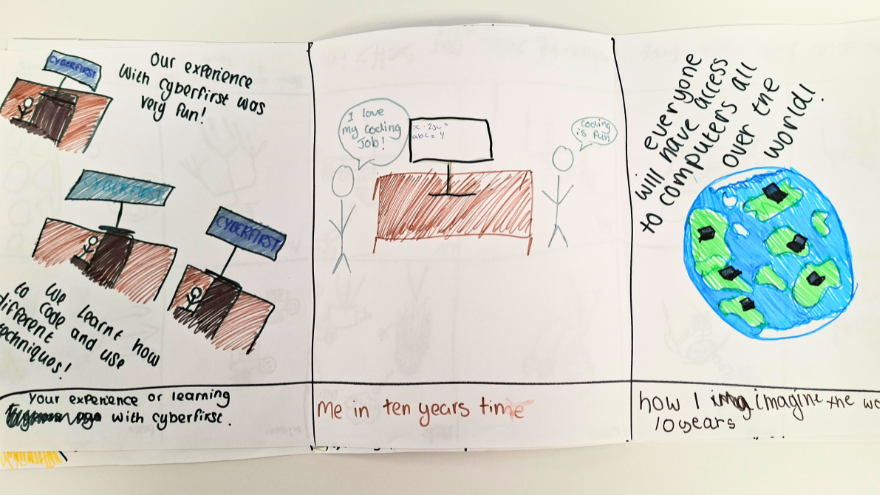
At CyberFirst Wales, we know that the strongest programmes are shaped by the people they serve. That means listening to learners, teachers, industry partners and the wider education community across Wales. Our recent work with the Co-production Network for Wales gave us the opportunity to do exactly that, bringing together around 100 participants, across industry, education and young people, to reflect on what is working well, what needs to grow, and what young people in Wales need from the expanded TechFirst Wales programme.
What came through clearly was a real sense of pride in the progress already made. Learners spoke enthusiastically about practical activities, competitions, industry role models and experiences that helped bring technology to life. Teachers highlighted stronger confidence, increased interest in computing, and positive impact on learners choosing Computer Science, especially girls. Industry partners also recognised the value of connecting earlier with young people and showing them the range of opportunities available.
As the national picture continues to evolve and the conversation increasingly looks ahead to TechFirst, these findings offer something important. They show that there is a strong foundation to build on in Wales. They also show that the next phase should be shaped carefully, with a clear focus on what learners, schools and partners say matters most. TechFirst is intended to build on the success of CyberFirst, broadening into a wider range of frontier technologies while continuing to support young people with digital skills, confidence in AI, and insight into future careers. That wider direction was welcomed by many participants, but with an equally strong message that cyber should also remain a trusted and visible foundation.
What participants told us
Several themes came through consistently across the engagement:
related
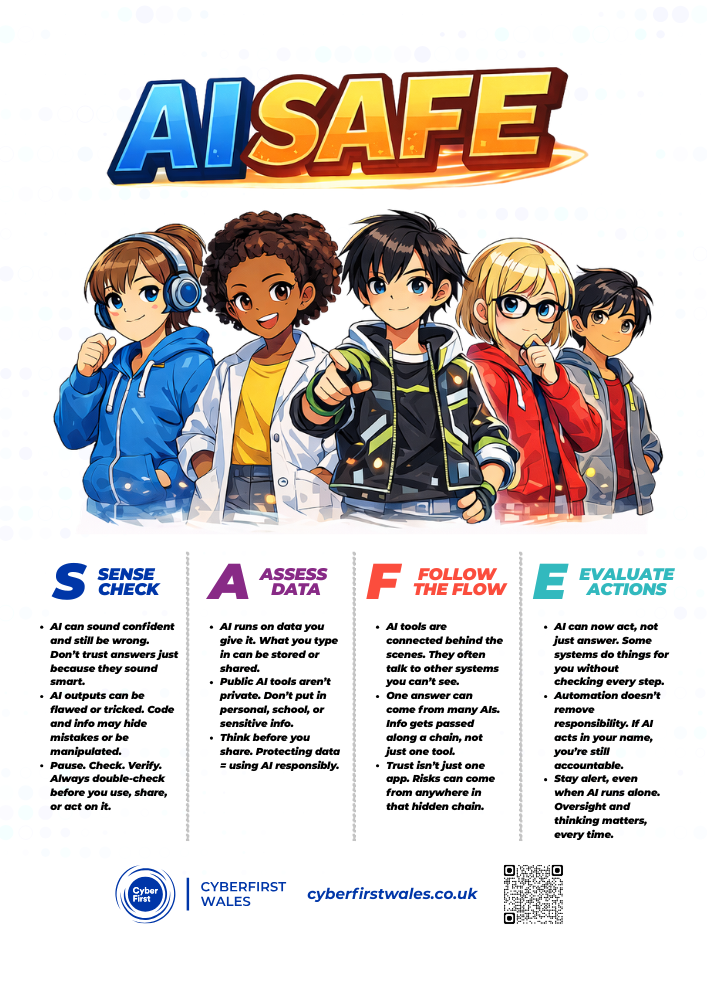
AI SAFE – A Framework for Students and Teachers
We have created a FREE evidenced based resource to help students and teachers navigate this new dynamic era of learning and study safely and confidently.
One of the strongest insights from the work was that young people need both technical and non-technical skills. Participants spoke positively about knowledge gained in areas such as cyber security, AI, coding, cryptography, and forensics. At the same time, teachers and employers placed just as much value on problem-solving, teamwork, resilience, communication and confidence. These are the skills that help young people succeed not only in classrooms, but also in real workplaces and future careers.
The discussions also highlighted the importance of perception. Many respondents said cyber and technology are still too often seen as being for a narrow group of learners. That remains a barrier in schools and beyond. The encouraging message was that when learners take part in CyberFirst activities, those views begin to shift.
Participants pointed to the importance of relatable role models, practical demonstrations, and clearer examples of local jobs and local pathways. That matters if we want more young people from different backgrounds to feel that they belong in this space.
For teachers, the message was practical and consistent. Many schools are working hard in a fast-moving landscape, often with limited time, limited equipment and limited access to specialist support. There was strong demand for off-the-shelf resources, more up-to-date content, and stronger links between schools, colleges, universities and industry. That kind of joined-up support is essential if cyber and frontier technology education are to remain relevant, inclusive and sustainable across Wales.
Another key theme was the importance of reaching learners at the right points in their journey. This is something CyberFirst Wales has already been doing effectively through its engagement framework, which supports learners at different stages with age-appropriate opportunities that build interest, confidence and progression over time. Participants’ feedback reinforced the value of that approach, while also highlighting the need to extend its reach so that more young people across Wales can benefit. There was particular support for widening access both earlier and later in the learner journey, alongside making post-16 pathways more visible, especially technical and vocational routes, so that more learners can see the full range of opportunities available in frontier technologies.
Looking ahead with confidence
The findings offer a clear and balanced message for the future. There is strong support for broadening the conversation around frontier technology, particularly around AI and other emerging areas. At the same time, there is a clear desire to protect what already works well. Cyber, one of the 7 frontier technologies defined by UK government, continues to be one of the most effective ways to spark interest, build confidence and open up pathways into the wider digital world. In Wales, that foundation matters. It has credibility with learners, teachers and industry, and it provides a strong base from which to grow.

Looking ahead to the future of tech education in Wales, the opportunity is not simply to do more. It is to do more with purpose. That means keeping inclusion at the centre, supporting schools in practical ways, widening access across the nation, and making sure that young people can see a pathway forward that feels relevant to their lives and ambitions. It also means continuing to work in partnership, because the future in Wales will be strongest when it is built together.
We are grateful to everyone who contributed their time, ideas and honesty to this work. Their insight will help shape what comes next and strengthen our shared ambition to create more opportunities, in more places, for more young people across Wales.
Read the full report
The TechFirst Expansion in Wales stakeholder engagement and evaluation report was carried out independently by The Co-production Network for Wales.