

For most of the AI era so far, using artificial intelligence has been visible. We open a laptop, take out a phone or visit a chatbot. That may be changing. AI is moving into glasses, earbuds, pendants and other devices designed to stay with us throughout the day. For schools, this is not simply another technological development. It could change how learners interact with AI, how people trust one another and how we recognise when AI is present at all.
From AI we use to AI that accompanies us
Imagine a learner looking at a science experiment and quietly asking why something has changed colour. Their glasses can see what they are looking at and an AI assistant provides an explanation. Another learner hears a live translation through their earbuds. Someone wearing a small pendant records a lesson and later asks their AI to find the part where a particular idea was explained.
These capabilities are no longer confined to science fiction.
AI is beginning to move away from the traditional screen and into devices that remain physically, and perhaps emotionally close to us.
Meta already offers AI-enabled glasses, is developing its Muse Charm, while its Neural Band explores subtle gesture control. Apple’s AirPods support hands-free AI interaction and live translation, while reports suggest that future earbuds may include cameras capable of giving AI visual information about the wearer’s surroundings. Other devices, including Amazon’s Bee and products such as Plaud’s NotePin, explore wearable AI that can capture conversations and turn them into searchable information, summaries or actions.
Some of these products are available now. Others are still in development. The individual devices matter less than the direction of travel. How we interact with AI will change.
“Always on” does not mean “always recording”
That distinction is important.
Different devices listen, record, process and store information in different ways. Some require deliberate activation. Some provide private audio assistance. Others capture information to create memories or summaries. Ambient AI is therefore better understood not simply as technology that records constantly, but as:
AI that remains readily available within our physical environment, able to sense, remember, respond or act without requiring us to begin an obvious AI session.
For education, that seemingly small interface change could have significant consequences. AI is becoming easier to consult without interrupting what we are already doing.
What do we actually know?
Research specifically examining children routinely carrying personal ambient AI through school is still very limited.
There is, however, evidence that wearable and augmented reality technology can support learning when its use is purposeful.
A 2026 peer-reviewed study involving 84 children aged five to seven found high levels of behavioural, academic, cognitive and social engagement when augmented-reality smart glasses were used during science activities. Shared AR experiences also supported collaboration and communication. But this was a planned educational activity supported by teachers and researchers. It was not a study of learners carrying consumer AI assistants through an ordinary school day which is a significant difference.
The emerging question is not simply whether wearable technology can support learning. It is what happens when AI becomes a constant companion rather than a deliberate classroom resource.
A cultural shift as much as a technological one
Schools already have social expectations around technology. We can see when someone takes out a phone. We know when a laptop is open during an assessment. We generally understand when somebody is filming. Wearable AI can make those signals less obvious. Someone wearing earbuds could be listening to music, translating a lesson or receiving AI-generated assistance. A small pin could be jewellery, an accessibility device or something creating an AI memory of the conversation taking place around it. Smart glasses may look increasingly like ordinary glasses.
The challenge is therefore not simply regulating another category of device. It is deciding what social expectations should exist when using AI no longer necessarily looks like using AI.
That brings us to trust.
What happens to trust in AI?
There is already evidence that people do not relate to AI in exactly the same way that they relate to conventional software.
A 2025 peer-reviewed study involving university students found that more human-like forms of trust influenced their willingness to rely on an AI chatbot. The researchers argue that the aim should be appropriately calibrated trust, rather than simply encouraging people to trust AI more. Wearable AI could make that relationship more significant.
An answer on a screen is one thing. An answer whispered into your ear while you are looking directly at a problem may feel different.
The AI appears to be sharing the experience with you. As interaction becomes more immediate, learners still need to retain the moment of judgement that asks:
Should I trust this?
What happens to trust between people?
There is another relationship at stake.
The Information Commissioner’s Office has highlighted exactly this wider challenge, arguing that smart glasses and AI wearables raise questions not only about privacy, but also about social expectations, transparency and public trust. This makes ambient AI more than an IT issue. Its presence can change the social environment even before anything technically goes wrong.
When trust becomes a chain
There is a third form of trust involved. A learner may believe they are trusting their glasses, earbuds or pendant. But the visible device may rely on a phone, a cloud service, an AI model and other connected applications. One system trusts another, which may depend on another in turn.
This is transitive trust.
The user may never consciously decide to trust every system in that chain, yet the outcome depends upon all of them. That gives schools a useful cybersecurity question:
What else are we trusting because the AI trusts it?
As AI becomes more connected, the thing we can see is not necessarily the whole system we are relying upon.
When the physical world becomes part of the attack surface
Wearable AI also creates unusual cybersecurity risks.
If AI can interpret what somebody sees, then the physical environment becomes input to the system. In 2026, researchers demonstrated physical prompt injection against vision-language models used with wearable devices. Malicious written instructions placed within the environment were able to manipulate model responses. This is emerging research published as a preprint, not evidence of widespread real-world attacks. But it demonstrates an important possibility.
A malicious instruction may not always arrive through an email, website or document. It could be something the AI sees or hears.
That extends a familiar cybersecurity principle into the physical world: not everything entering an AI system should automatically be trusted.
Assessment when AI becomes harder to see
Wearable AI also challenges a familiar assumption in education: that we can usually observe when a learner is using technology. If assistance is delivered through an earbud, displayed inside glasses or activated through an unobtrusive gesture, distinguishing assisted and independent work becomes harder. This may eventually require more than new rules about prohibited devices.
Schools may need to become clearer about what assessment is actually measuring.
There is value in distinguishing between independent capability, what a learner can do without AI; augmented capability, what they can achieve with AI; and transfer, whether they can demonstrate understanding when assistance is removed.
Wearable AI makes that conversation more urgent.
Navigating ambient AI with AI SAFE
Trying to write a rule for every new wearable is unlikely to work for long. The products will change and we will see more and more of them in the coming years.
The questions can remain.
More than another device policy
Schools will need rules for wearable AI. There will be places where cameras, recording or external assistance are inappropriate. There will also be accessibility and educational uses where the same technology could offer genuine benefits. But the bigger challenge is cultural.
Glasses, earbuds and pendants are unlikely to be the end point. The smartphone made computing personal. Wearable AI may make it ambient.
The challenge for education will therefore not simply be teaching learners how to use AI. It will be helping them recognise when it is present, understand the relationships of trust it creates, question what it tells them and retain the judgement to decide when that trust is justified.
If we can no longer see when someone is using AI, how do we maintain trust in classrooms, assessments and conversations without creating a culture of surveillance ourselves?
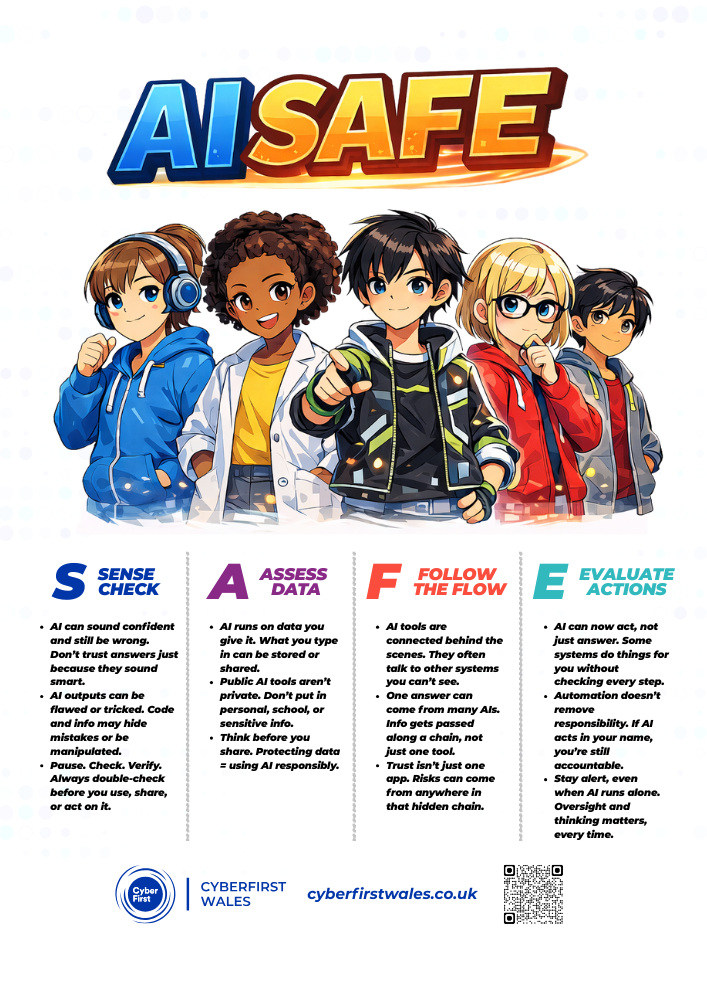
Support Tools
Want to know how AI is already being used in your school, and whether that use is safe, visible and supporting learning?
We’ve created free, practical staff resources to help turn the Shadow AI conversation into action. The pack includes the AI SAFE poster, quick-reference card for everyday decisions, and staff and learner activities to uncover current AI use, identify opportunities and spot areas where clearer guidance may be needed. Ideal for staff meetings, tutor time, INSET, professional learning and school AI policy discussions.
If you would like to discuss how this can be used in school, please get in touch.


