
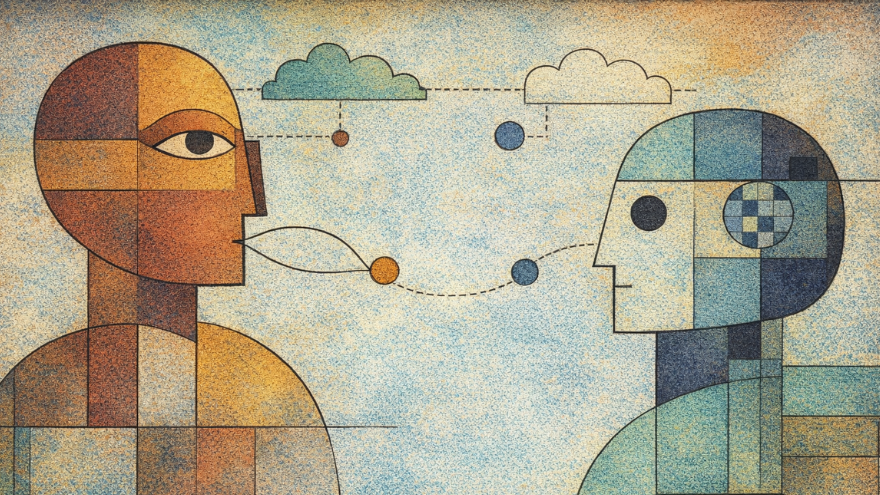
AI tools can generate text, write code and even take action. But they also rely on data. Every prompt, file or connection to a system involves information being processed, and sometimes stored. Understanding how data flows through AI systems is essential for teachers and students using these tools safely.
AI is not just a tool, it is a data processor
Artificial intelligence tools are often presented as simple assistants. You ask a question and receive an answer. However, behind this interaction is a more important reality. AI systems process and sometimes store the information they are given.
When a user enters a prompt, uploads a document or connects an AI system or agent to another platform, they are sharing data. This might include personal information, school work or sensitive organisational details.
Every interaction with an AI system is also a data exchange.
Guidance from the Information Commissioner’s Office makes clear that organisations must understand how personal data is used when adopting AI tools. This includes knowing where data is processed, how long it is stored and who has access to it.
Where the risks come from
The risks associated with AI and data do not always come from deliberate attacks. In many cases, they arise from everyday use.
For example, a student might paste coursework into an AI tool to improve it. A teacher might upload a document to generate a summary. In both cases, information is being shared with an external system.
Research has shown that sensitive data can sometimes be reproduced or inferred from AI systems under certain conditions, particularly where safeguards are limited. While modern systems have improved, the risk has not disappeared entirely.
There is also the possibility of accidental exposure. If AI tools are connected to documents, emails or shared drives, they may access more information than the user expects.
Guidance from the National Cyber Security Centre highlights that connecting AI systems to wider services increases the potential impact of data exposure, especially where permissions are not carefully controlled.
The difference between public and managed tools
Not all AI tools handle data in the same way. This is an important distinction for schools and educators.
Publicly available AI tools may:
In contrast, managed or enterprise tools are more likely to:
The Information Commissioner’s Office advises organisations to carry out data protection impact assessments when introducing AI systems, particularly where personal data is involved.
Understanding this difference helps schools make informed decisions about which tools are appropriate in an educational setting.
How this connects to other risks
The risks associated with data do not exist in isolation. They connect directly to the issues explored in other articles in this series.
If AI generated code is not fully understood, it may expose data unintentionally. If an AI system is vulnerable to prompt injection, hidden instructions could lead to sensitive information being revealed. If an AI agent has access to systems and data, it may act on that information in ways that were not intended.
The more access an AI system has to data, the greater the potential impact if something goes wrong.
This means that data risk is not a separate issue. It is part of a wider picture where AI capability and access combine to create new forms of exposure.
Why this matters for students
It is easy to see AI tools as private or personal, particularly when they are accessed through individual accounts. However, the information entered into these systems may be processed in ways that are not immediately visible.
For students, understanding data risk is now a key part of digital literacy.
Students need to develop simple but important habits. They should think carefully about what they share, particularly when it involves personal information or work that has not yet been submitted.
The Information Commissioner’s Office emphasises the importance of data minimisation. This means only sharing the information that is necessary for a specific task.
Why this matters for teachers and schools
For teachers and school leaders, the use of AI raises broader considerations around safeguarding and data protection.
Schools are responsible for protecting student data and ensuring that systems are used appropriately. This includes understanding how AI tools interact with student information, internal systems and external services.
Guidance from the National Cyber Security Centre recommends taking a cautious approach to integrating AI with existing systems, particularly where sensitive data is involved.
This may involve selecting and subscribing to approved AI tools, limiting integrations and providing clear guidance and training to staff and students.
Reducing the risk in practice
Reducing data risk does not require avoiding AI altogether. Instead, it involves using it in a controlled and informed way.
A key principle is to limit what is shared. Users should avoid entering sensitive or personal information unless they are confident in how it will be handled.
It is also important to understand permissions. AI tools should only have access to the data and systems they need to perform a specific task.
Human oversight remains essential. Outputs should be reviewed, and any actions taken by AI systems should be checked, particularly in educational contexts.
These approaches align with broader UK guidance on secure and responsible use of technology in education.
Navigating Information Risk with AI SAFE
The AI SAFE framework can be used in both classroom and leadership setting to better understand the way AI systems control, handle and share data
Looking ahead
As AI becomes more integrated into education, questions about data will become increasingly important. The benefits of these tools are clear, but they rely on access to information.
There has been progress. Many AI providers are improving transparency, offering better controls and reducing how data is retained. At the same time, regulators such as the Information Commissioner’s Office are providing clearer guidance.
However, the underlying challenge remains. AI systems depend on data, and the way that data is used is not always visible to the user. By helping students understand how data flows through AI systems, and by encouraging responsible use, schools can ensure that these tools are used safely.
Used well, AI can support learning and creativity. The key is to ensure that this is balanced with awareness of how data is shared, processed and protected.
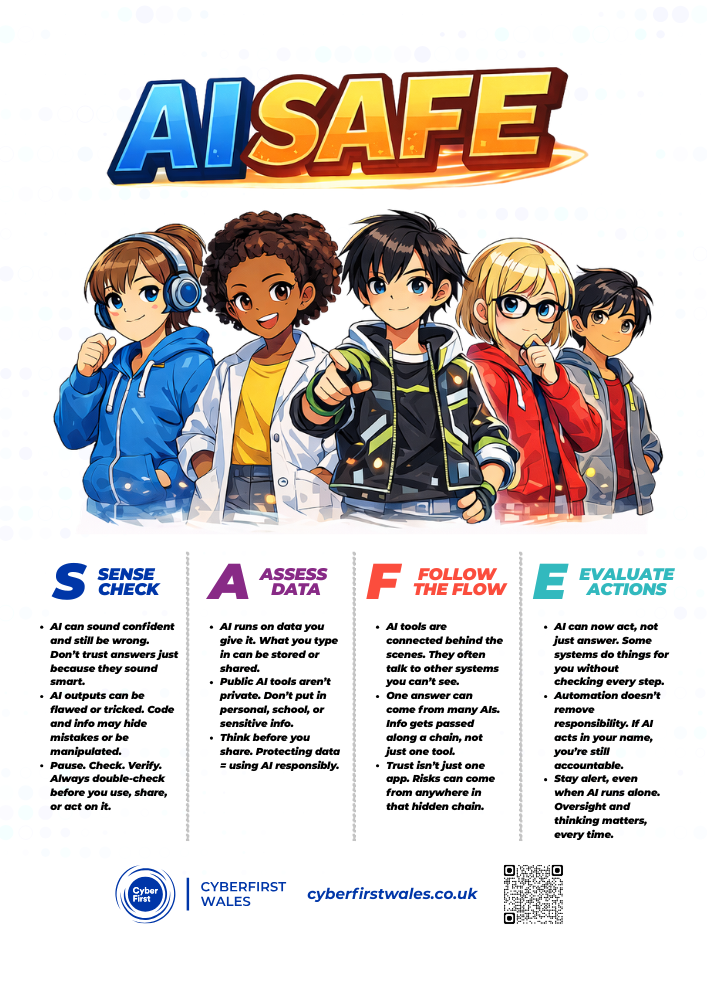
AI SAFE – A Framework for Students and Teachers
We have created a FREE evidenced based resource to help students and teachers navigate this new dynamic era of learning and study safely and confidently.